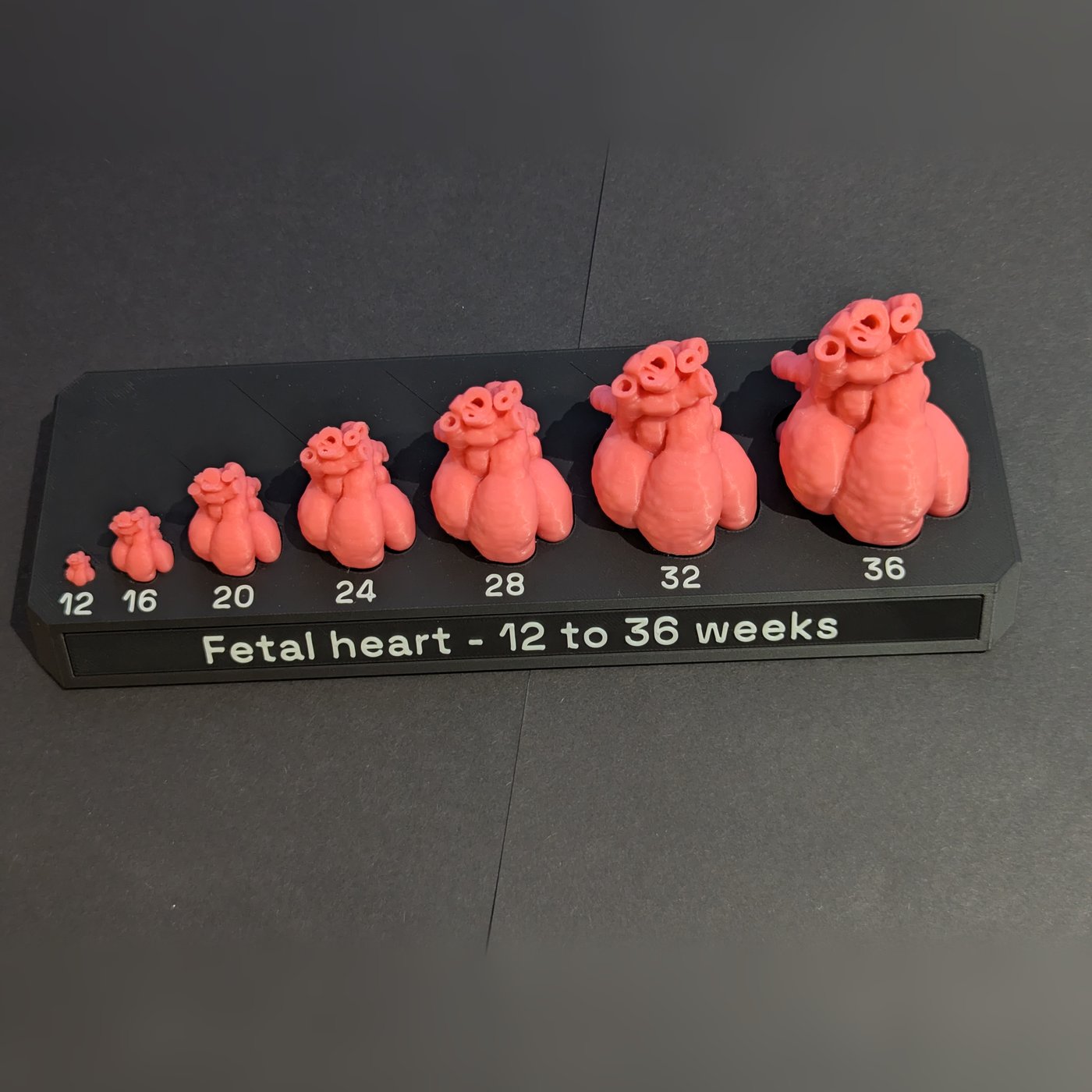
Fetal heart – Sizes, 12 to 36 weeks
Seven hearts, four weeks apart · On a stand labelled by week
Seven fetal hearts from 12 to 36 weeks, each printed at the size a heart is at that gestation. The 12-week heart is under a centimetre across.
New release price. Save £45 off the £134 list price until 18 January 2027, or until this first batch sells out if that is sooner.
Secure checkout by Stripe. Card details never touch our servers. By buying, you agree to our terms of sale.
About this model
The set shows how big the fetal heart really is through pregnancy, and above all how small it is early on. At 12 weeks, around the time of the first scan, the heart is under a centimetre across, and at the 20-week scan it is still under 3 cm. Holding them shows why a clear view of the heart is so hard to get.
Every heart in the set is the same model: our standard fetal heart, which is the size of a 34-week heart, scaled to the size a heart is at each gestation. They are not separate models of the heart at each age. The shape is the same in all seven, and only the size changes.
Each heart is a single piece, with nothing to take apart. The 12, 16 and 20-week hearts are solid, as they are too small for hollow walls. From 24 weeks they are hollow, with the vessel ends open. They stand in a row of pockets, smallest to largest, with the week in front of each, and lift out to be held or passed round.
What it shows
The size of the fetal heart at 12, 16, 20, 24, 28, 32 and 36 weeks. Along its longest side the heart is about 9 mm at 12 weeks, 18 mm at 16, 27 mm at 20, 36 mm at 24, 44 mm at 28, 52 mm at 32 and 59 mm at 36.
The 20-week heart is half the size of a 34-week heart in every direction, so an eighth of its volume. The 12-week heart is about a sixth of the 34-week heart's size.
Each heart is the average size for its gestation. Real hearts vary around it, proportionally more at the younger end of the set.
Where the anatomy comes from
Every heart in the set starts from the normal fetal heart atlas published by King's College London (Uus and colleagues, Journal of Cardiovascular Magnetic Resonance, 2022), the same geometry as our other heart models. The atlas combines the MRI of 28 healthy fetuses at 29 to 34 weeks into one average heart, and its cardiac circumference, measured on the four-chamber view, is that of a 34-week heart.
Each age is that heart scaled to the cardiac circumference expected at that gestation, from the growth chart published by Traisrisilp and colleagues (Journal of Ultrasound in Medicine, 2011). The chart covers 14 to 40 weeks, so the 12-week size extends it by two weeks.
The set shows size, not development. The chambers, outflow tracts and arches are all formed by about 8 weeks, so the arrangement is right at every age in the set, but the proportions throughout are the 34-week heart's, and a younger heart's differ a little.
Specification
- Material
- PLA
- Source data
- SVRTK fetal MRI atlas, 0.6 mm isotropic
- Gestational age
- 12, 16, 20, 24, 28, 32 and 36 weeks
- Scaled from
- Our 34-week heart, from atlas imaging at 29 to 34 weeks
- Sizes
- About 9, 18, 27, 36, 44, 52 and 59 mm along the longest side, 12 to 36 weeks
- Pieces
- Seven hearts, each one piece, and a stand
- Build
- Solid at 12, 16 and 20 weeks, hollow from 24 weeks
- Stand
- About 235 × 82 mm, 65 mm tall with the hearts in place
Educational model, not a medical device. This is a teaching aid. It is not intended or approved for clinical diagnosis, treatment, surgical planning, or any patient-specific decision. The geometry comes from a published, anonymised fetal MRI atlas, not from an identifiable patient, and it represents atlas-average anatomy rather than any individual.