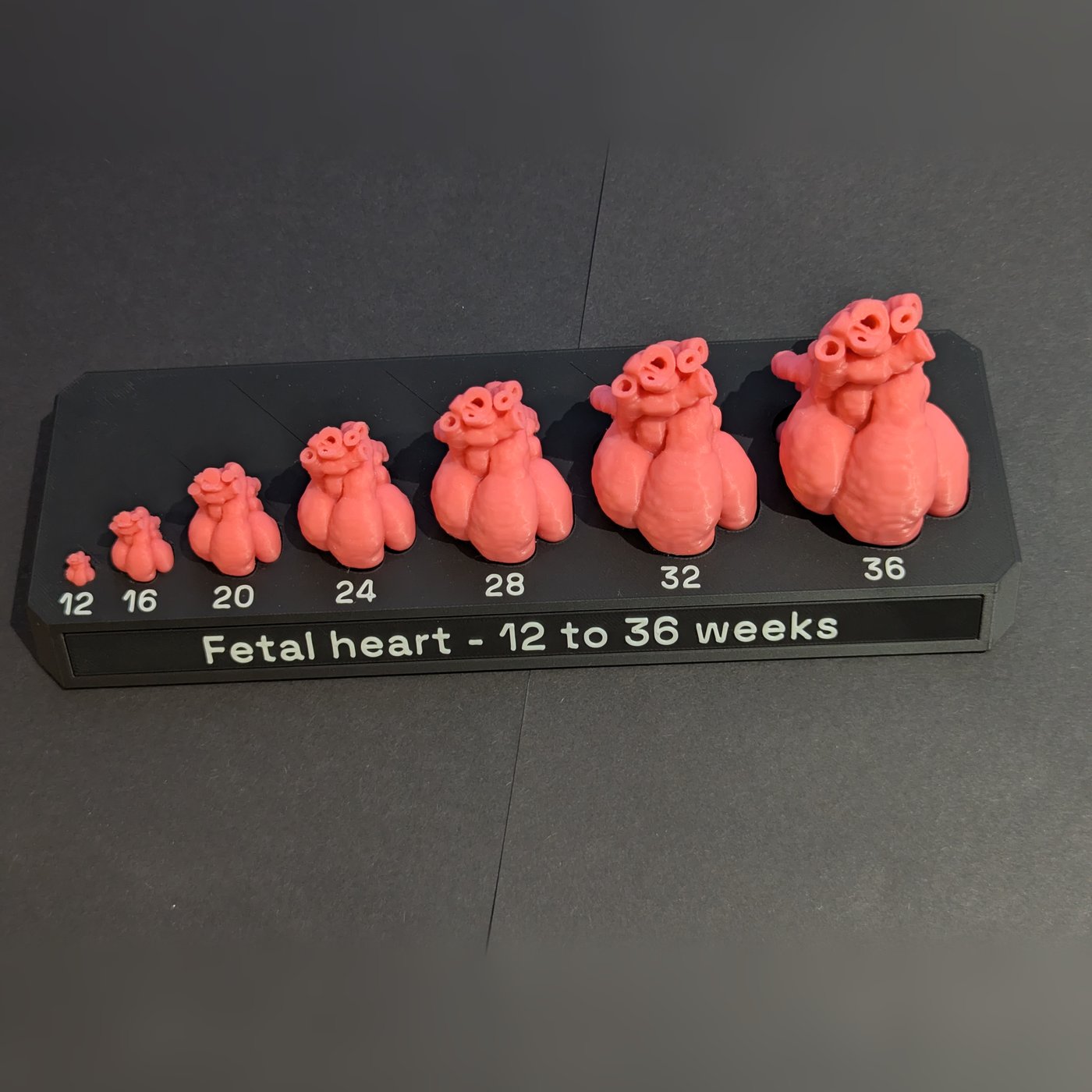
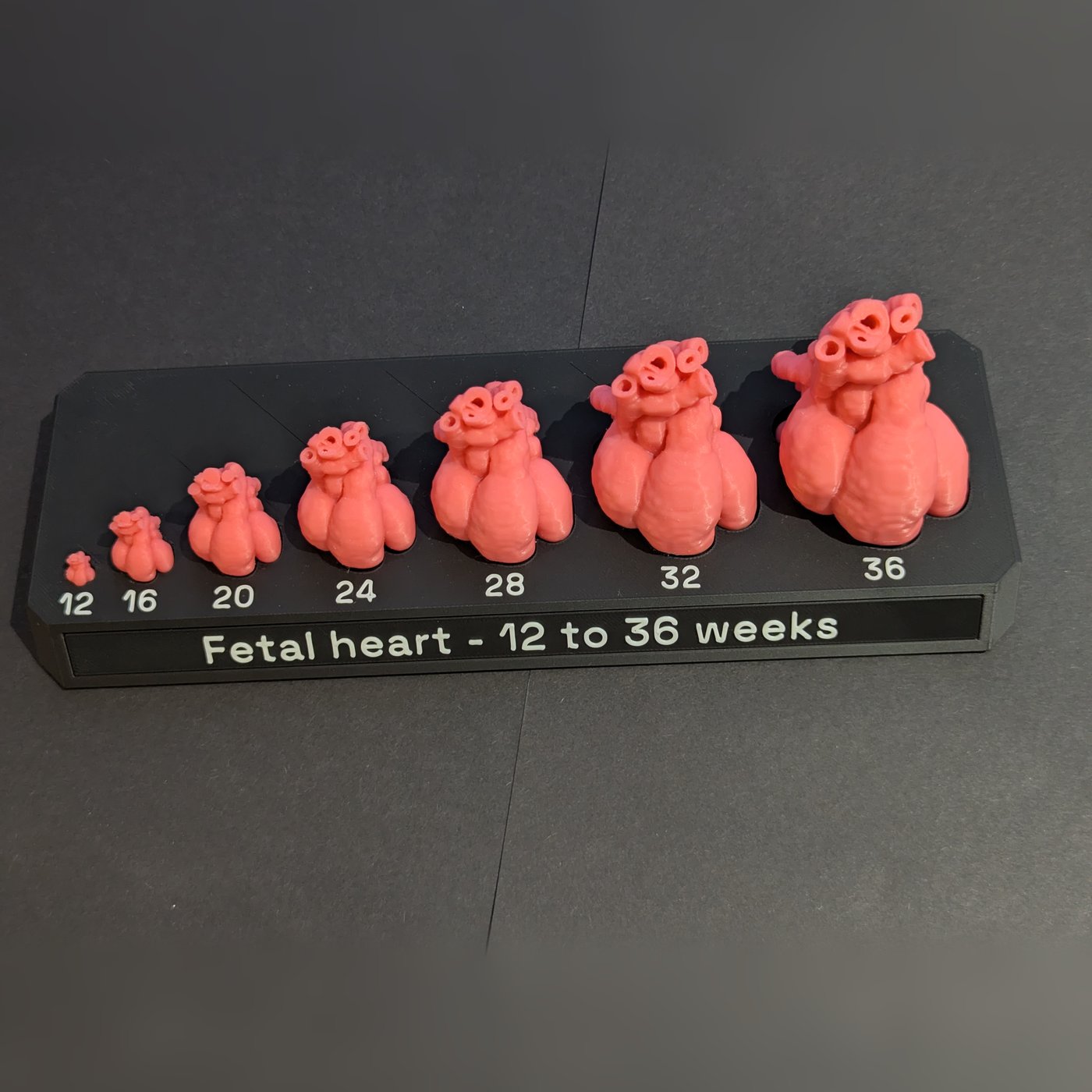
At 12 weeks, around the time of the first scan, the fetal heart is under a centimetre across. At the 20-week scan it is still under 3 cm. Numbers like these are easier to grasp in the hand than on a page, so we made a set of seven hearts, one every four weeks from 12 to 36 weeks, each printed at the size a heart is at that gestation. This page gives the fetal heart size by week from that set, and where each size comes from.
Fetal heart size by week
The size given for each heart is the longest of its three dimensions as it stands, in millimetres, rounded to the nearest millimetre and measured off the 3D model it is printed from. The model includes the first part of the great vessels above the heart, so the measurement takes those in too. It is a way to picture the whole heart, not a measurement taken on a scan.
| Gestation | Longest side of the model | Cardiac circumference it is scaled to | Scale, 34-week heart = 1 |
|---|---|---|---|
| 12 weeks | 9 mm | 20.6 mm (extrapolated) | 0.16 |
| 16 weeks | 18 mm | 42.9 mm | 0.33 |
| 20 weeks | 27 mm | 64.1 mm | 0.50 |
| 24 weeks | 36 mm | 84.2 mm | 0.65 |
| 28 weeks | 44 mm | 103.1 mm | 0.80 |
| 32 weeks | 52 mm | 121.0 mm | 0.94 |
| 36 weeks | 59 mm | 137.7 mm | 1.07 |
Read down the second column and the heart triples in length between 12 and 20 weeks, from 9 mm to 27 mm, then a little more than doubles again by 36 weeks. Up to 24 weeks it adds 9 mm every four weeks; after that the gain is 7 to 8 mm. Length understates the change. The 20-week heart is half the size of a 34-week heart in every direction, so an eighth of its volume, and the 12-week heart is about a sixth of the 34-week heart's size.
Where the sizes come from
Every heart in the set starts from the same geometry as our other heart models: the normal fetal heart atlas published by King's College London (Uus and colleagues, Journal of Cardiovascular Magnetic Resonance, 2022). The atlas is not a scan of one fetus. It combines the MRI of 28 healthy fetuses at 29 to 34 weeks into one average heart, so its anatomy is typical rather than any one baby's. Measured on the four-chamber view, its cardiac circumference is 128.9 mm, which is that of a 34-week heart. How that atlas becomes a printed heart is in how we make a 3D-printed fetal heart model.
Each age is that heart scaled to the cardiac circumference expected at that gestation, from the reference chart published by Traisrisilp and colleagues (Journal of Ultrasound in Medicine, 2011;30:1191–6). The scale in the last column is the circumference for that week divided by the 34-week heart's 128.9 mm. Cardiac circumference suits the job because it measures the whole heart rather than any one chamber. The chart covers 14 to 40 weeks, so the 12-week size extends it by two weeks. The 36-week heart, at 1.07, is the only one scaled up.
Each heart is the average size for its gestation. Real hearts vary around it, proportionally more at the younger end of the set: on the same chart, one standard deviation is about 7% of the average circumference at 20 weeks, and about 14% at 12 weeks by extrapolation. The set shows typical sizes for teaching and says nothing about any individual baby.
Why the size matters for scanning
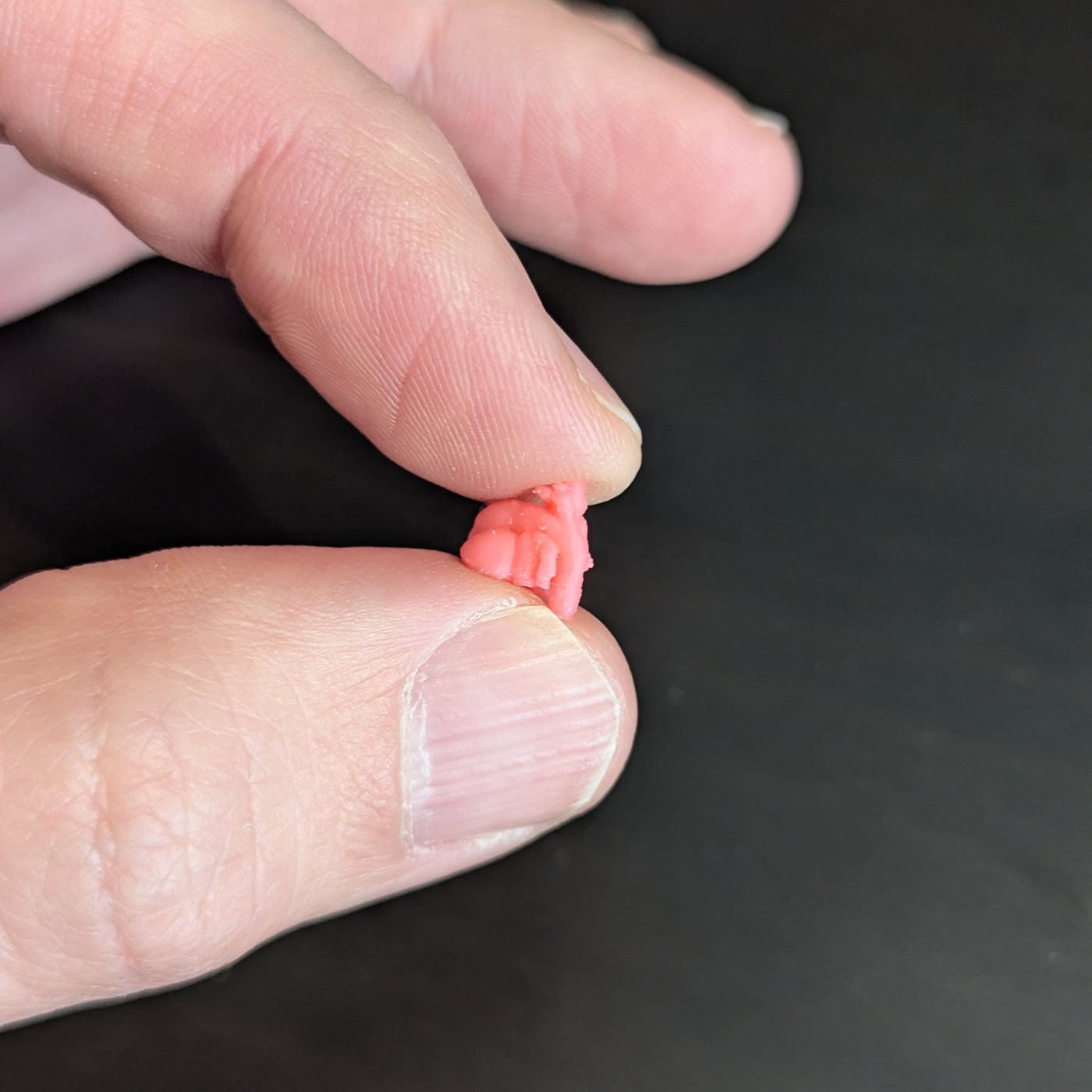
Pick up the 12-week heart and the difficulty of scanning the heart early in pregnancy is plain. Everything a cardiac scan looks for, the four chambers, the two outflow tracts crossing as they leave the ventricles and the arches above them, is packed into something that sits on a fingertip. An ultrasound image can only separate structures down to a certain size, and at 12 weeks many parts of the heart are close to that limit. The heart is beating and the fetus is moving, so a clear view of something that small is there for a moment rather than held.
By 20 weeks the heart is three times the length, and every structure in it has grown in proportion. That is a large part of why the standard views of the heart are taken at the 20-week scan. Even then it is under 3 cm, and getting each view cleanly takes practice. Side by side, the 12 and 20-week hearts show a trainee what they are working with.
If you are pregnant and found this page while wondering about your own baby's heart, your sonographer, midwife or doctor is the person to ask.
One heart at seven sizes
Every heart in the set is the same fetal heart model: our standard heart, which is the size of a 34-week heart, scaled to the size a heart is at each gestation. They are not separate models of the heart at each age. The shape is the same in all seven, and only the size changes.
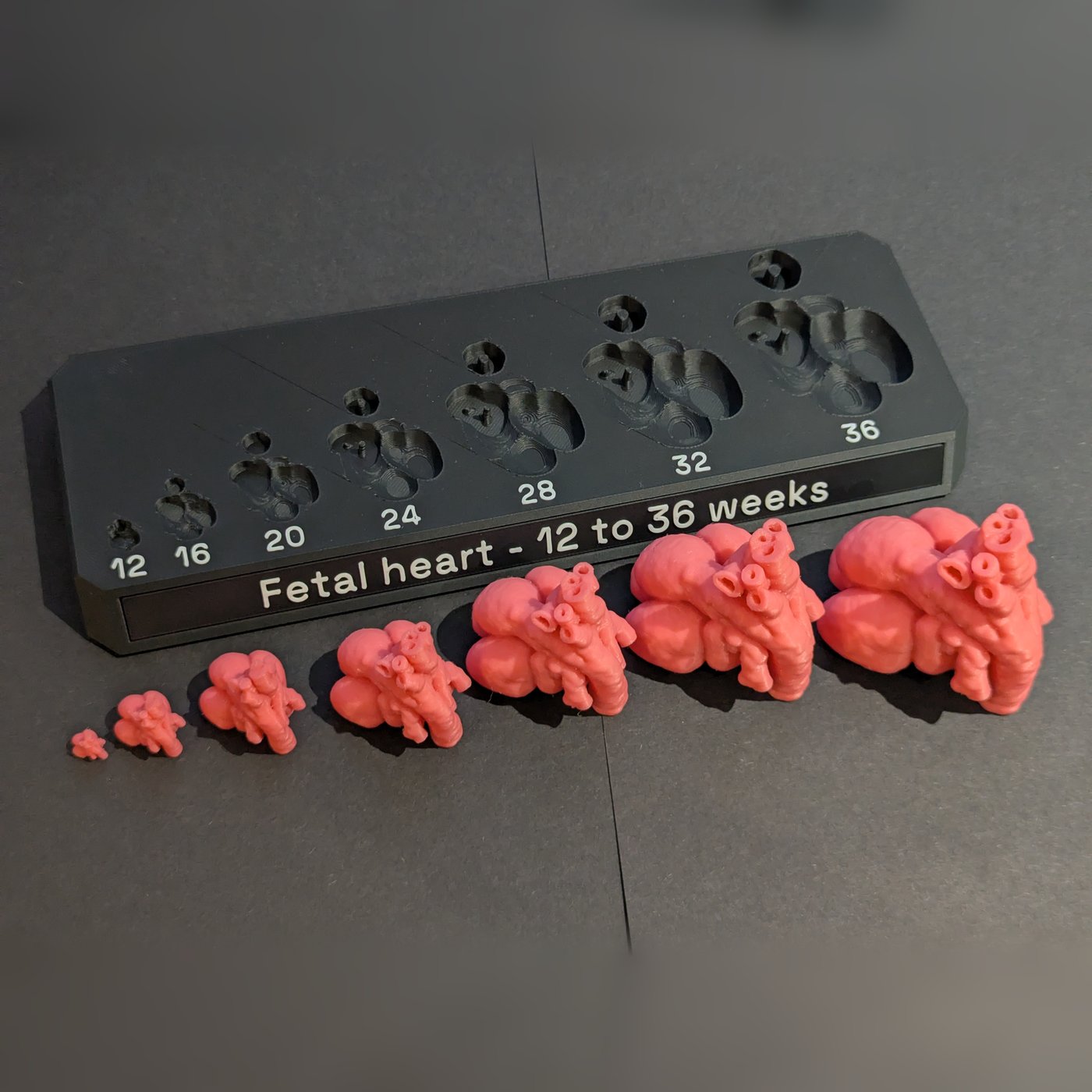
The set shows size, not development. The chambers, outflow tracts and arches are all formed by about 8 weeks, so the arrangement is right at every age in the set, but the proportions throughout are the 34-week heart's, and a younger heart's differ a little. Measurements from 18 weeks onwards (García-Otero and colleagues, Ultrasound in Obstetrics and Gynecology, 2021) find the atria and ventricles keep the same share of the heart's area on the four-chamber view, while the right ventricle grows a little relative to the left. So the younger hearts in the set slightly overstate the right side.
The set
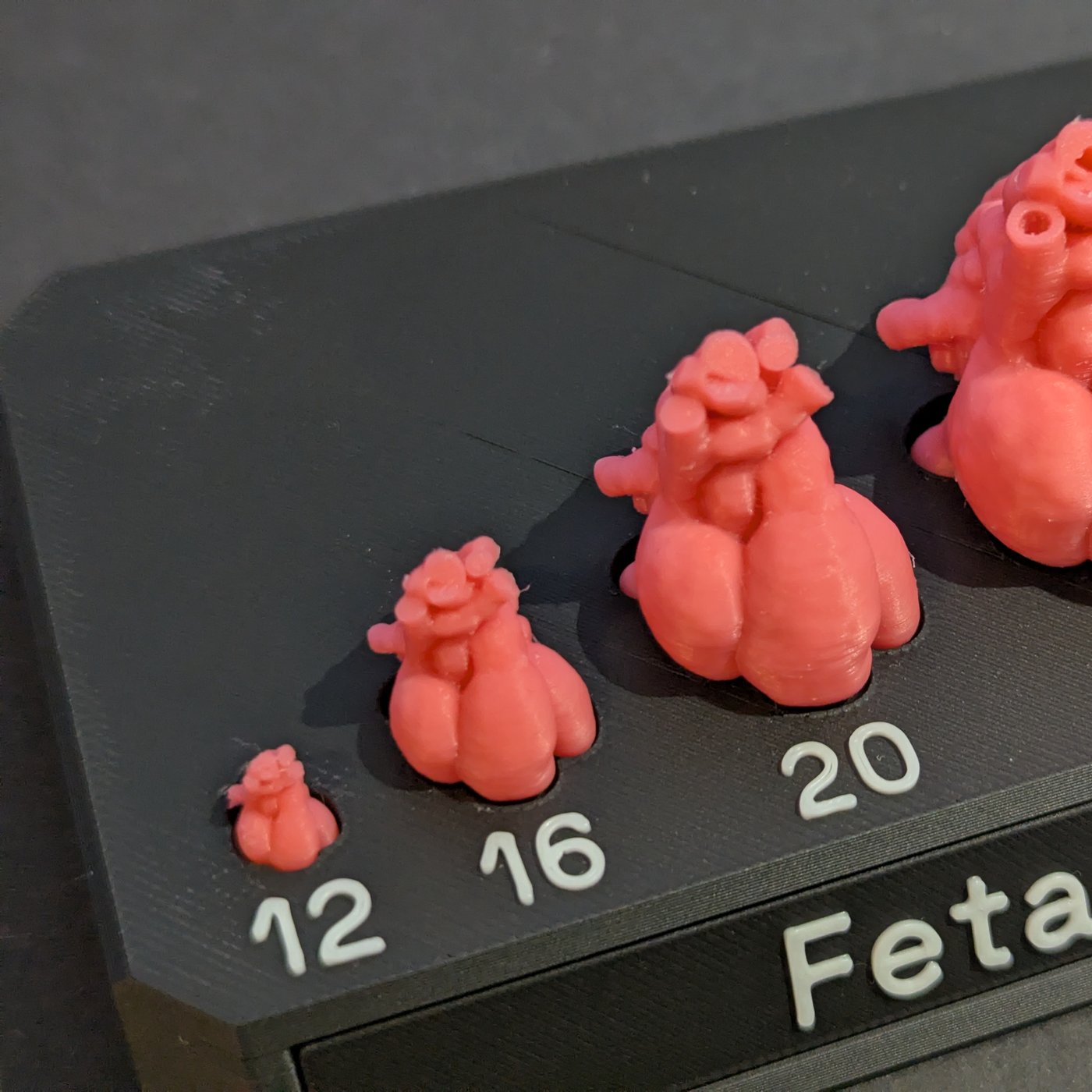
Each heart is a single piece, with nothing to take apart. The 12, 16 and 20-week hearts are solid, as they are too small for hollow walls. From 24 weeks they are hollow, with the vessel ends open. They stand in a row of pockets, smallest to largest, with the week in front of each, and lift out to be held or passed round.
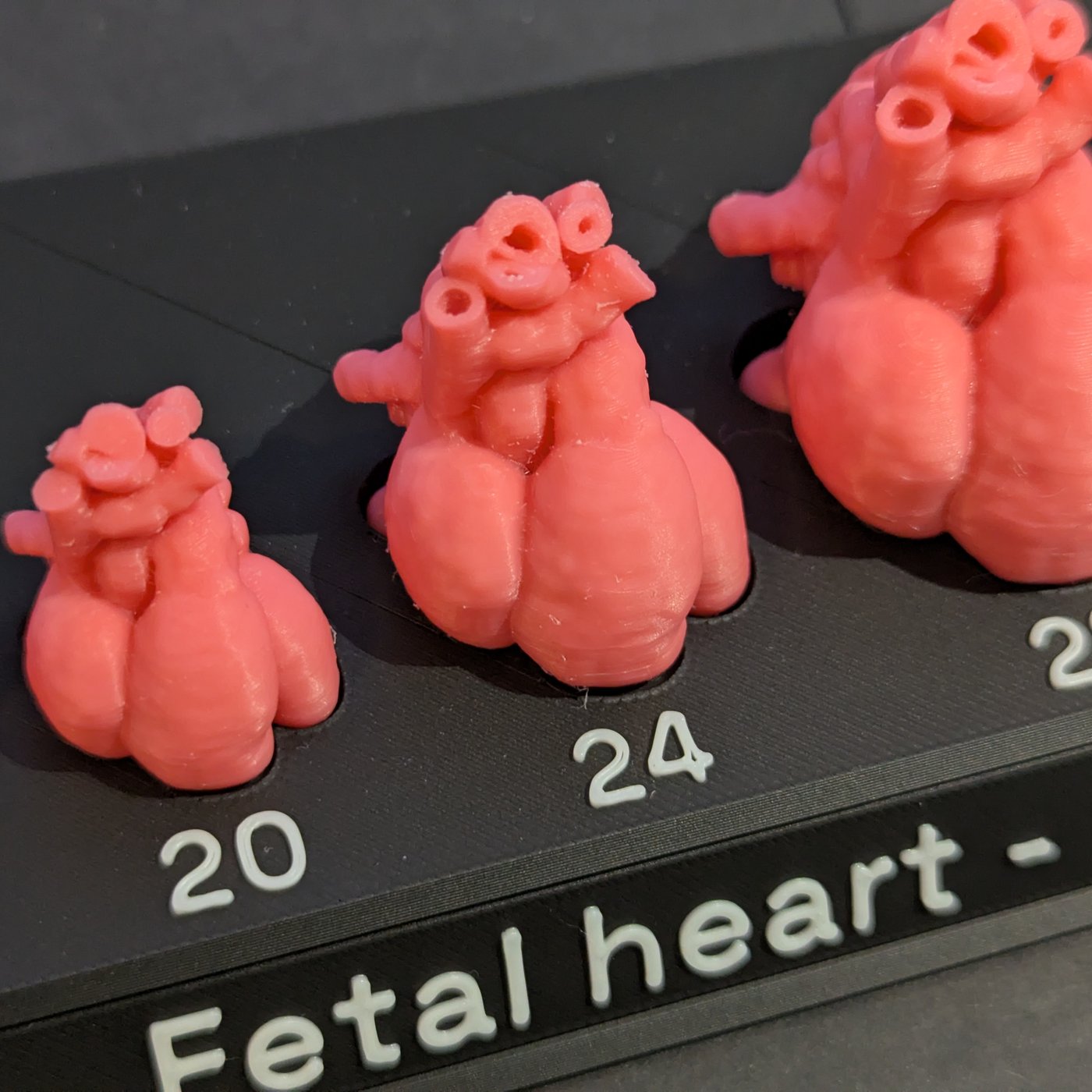
The seven hearts and their stand are sold together as the fetal heart sizes set, with a photograph of every week on the page.